

Part 5 of The case for pooled engineering
The migration has already started. Nobody announced it.
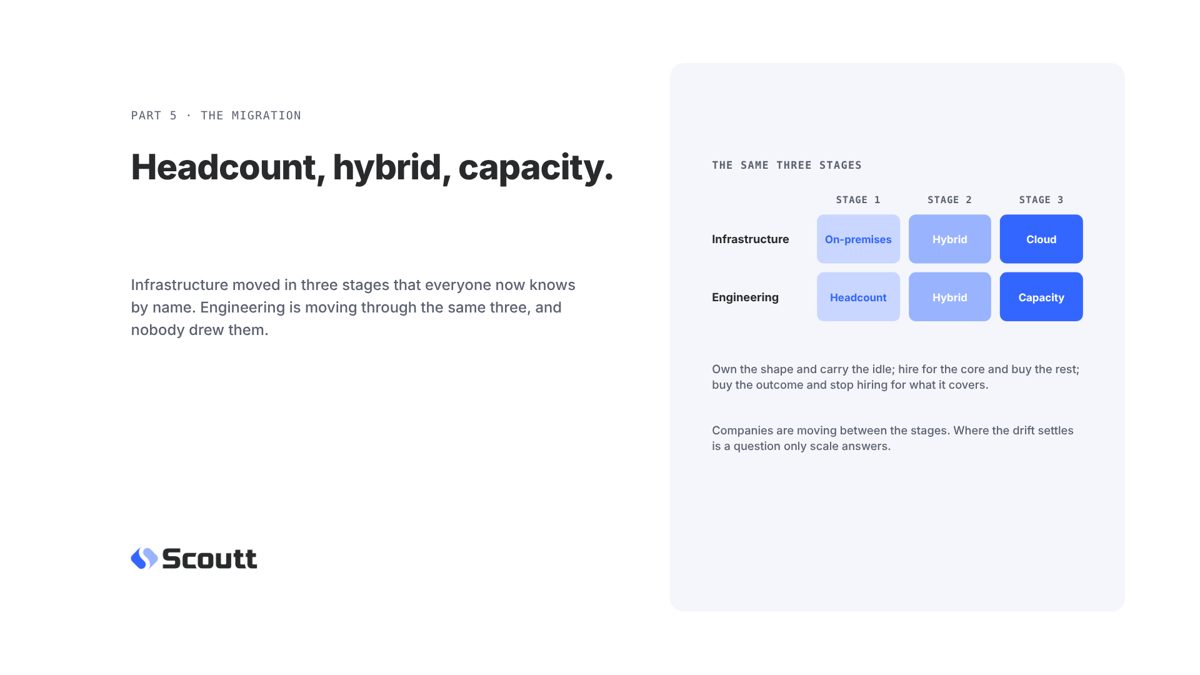
When cloud arrived, companies didn't switch. They moved, in stages, and the stages had names: on-premises, hybrid, cloud. Everyone kept their own servers until something made them try one workload elsewhere; then they ran both for years; then one day the server room was a storage closet and nobody could say exactly when that had happened.
I've been watching the same thing happen with engineering, in my own customer base, and the stages are the same three, with engineering's names: headcount, hybrid, capacity. In an earlier article, When you stop buying a person, what would you be buying?, I said what that capacity is; here I'll describe the move toward it, as it's happening.
Some customers hire engineers into their teams and nothing else. That's headcount, the on-premises of engineering. For a few it's the right call for the same reason owning servers was the right call for a bank: they have the scale to keep the specialists busy, the budget to carry the idle, and reasons of their own to keep the work close. For most it's simply where everyone was before there was another option, the way every company ran its own servers before there was a cloud to move to. Nothing about the argument I've been making says either group is wrong, any more than cloud said owning servers was wrong; there are still good reasons to run on-premises today, and there will still be good reasons to hire.
Some do both. They hire for the core roadmap, the thing that is the company, and when a side project comes along that they don't want to pull anyone off for, they buy it as capacity instead. That's hybrid, and it's where most companies I've seen sit, and it's where most of them stayed with infrastructure too: the sensitive workload on the floor, the rest in the cloud, for years. It isn't indecision. It's the sensible place to be while the trust builds.
And some have moved over. They buy capacity, they've stopped hiring for the disciplines it covers, and when I ask whether they'd hire the next engineer the answer is a shrug. They haven't thought about it in a while. That's capacity, the cloud stage, and it's the one that tells you the rest will follow, because nobody at that stage goes back.
We're seeing companies move between the stages. Some have gone from headcount to a mix, and from a mix to capacity. Infrastructure is the caution against calling that a direction too early: companies moved to the cloud in a wave, and some have moved workloads back since, for reasons that were good. The drift exists. Where it settles is a question only scale answers.
What the engagements so far do show is that the mechanism holds. A unit of capacity has run for most of a year, covered disciplines the company never hired, changed shape when the work changed, and come out the other side with a product and a launch date. The state, kept in the system, carried the work across people. And the stages appeared without anyone drawing them.
The way to answer the rest is to cross the threshold and report what you find. That's what I intend to do, and I'd rather say so plainly than claim the curve before I've seen it.
I've written the full argument down, as a technical whitepaper rather than a series of posts: the constraint, how it broke, what a pooled unit has to look like for the pooling to hold, where the cloud comparison helps and where it misleads, and what I've observed so far. It's vendor-neutral on purpose. I think this is something the industry is going to do, in many implementations, and I'd rather the argument be read on its own terms than as a pitch for mine.