

Part 4 of The case for pooled engineering
When you stop buying a person, what would you be buying?
Once the state lives in the system and the person stops being the only place it exists, the thing you buy could stop being the person. So what would it be? In an earlier article, The thing that made engineers un-poolable just left the building, I explained how the state got out; here I'll take up what you'd be buying instead, and how far the cloud comparison holds once you are.
Capacity. An amount of delivery, sized to the work, drawn from a pool that changes shape as the work changes. Not a team rented for a while, and not a project with a scope and a price, but the thing cloud sold instead of machines: a quantity of something that gets work done, that you can turn up and down, and that somebody else keeps busy when you aren't using it.
It's worth saying what that isn't, because the market already has things that sound like it. It isn't a staffing bench, where the people arrive cold and stay for months because the context has to be rebuilt inside each one of them; that's pooling the people and not the capacity. It isn't an agency or a services firm either. They do pool their people internally, and well, but they sell you the result as scope and a price, and the flexibility their pooling creates stays on their side of the invoice. What you'd be buying here is the flexibility itself: the right to have the shape of the work change without the shape of the team being renegotiated.
That's the idea, and I want to be careful with it, because this is the point where every "AWS for X" pitch goes wrong and I've sat through enough of them to know the moment. The mechanism is the same: uncorrelated demand, provisioned for the average, sold at the peak. The product isn't a copy, and the comparison misleads in places a technical reader will find on their own. I'd rather list them myself.
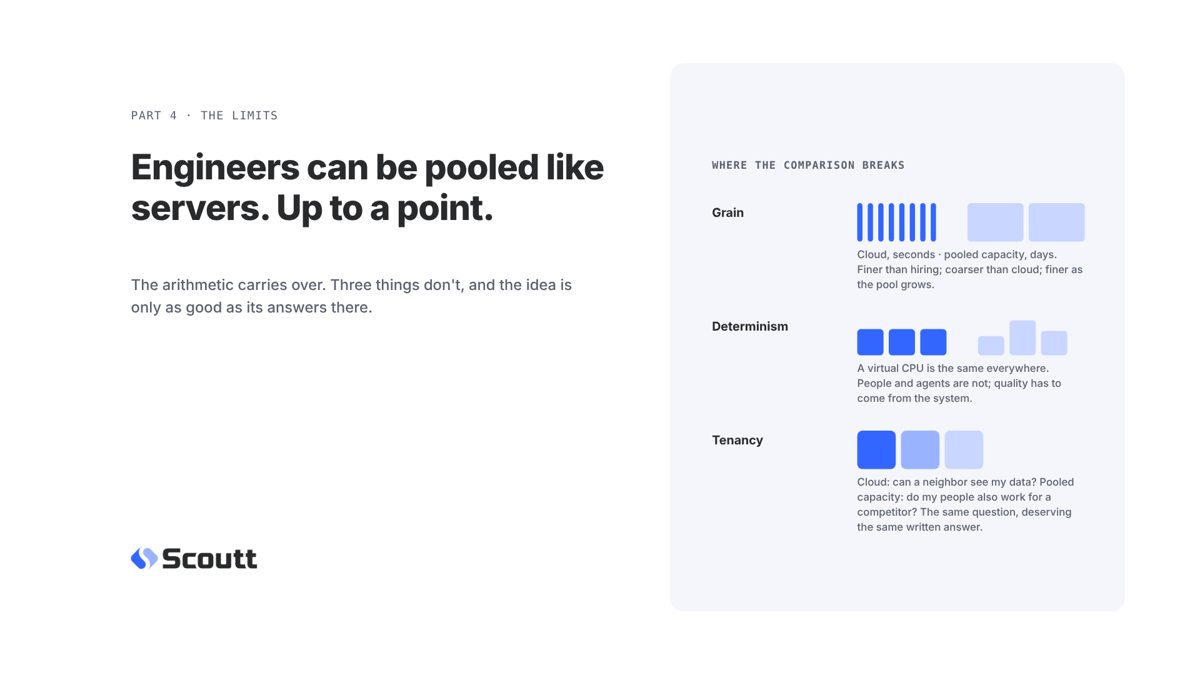
The grain is days, not seconds. Cloud scales to zero in a minute. Capacity made of people and agents gets added or released in days, and a burst upward is limited by what's already in the pool; you can't summon a security specialist in ninety seconds any more than you could before. Coarser than cloud, far finer than hiring, and finer as the pool grows, which means a small pool is worse at this than a large one and should say so. And when two customers need the same specialist in the same hour, one of them waits. That's the noisy-neighbor problem in its engineering form, and it doesn't go away because the arithmetic says peaks are rare; it only gets less frequent and more tolerable as the pool grows.
The resources aren't deterministic. A virtual CPU behaves the same wherever it lands. People and agents don't, and a customer who's been burned by a rotating cast of contractors will hear "pooled" and think "whoever was free." Cloud never solved unreliable hardware by finding reliable hardware; it made reliability a property of the system rather than of any component, with redundancy, health checks and automatic failover doing what no single disk could promise. Pooled capacity would have to make the same move: quality that comes from how the work is run, not from who happened to run it. Until it can show that, the objection stands.
And multi-tenancy raises the question it always raised. Cloud customers spent a decade asking whether a neighbor could see their data, and the vendors spent that decade answering in writing, with isolation models, audits and certifications. Customers of pooled capacity will ask whether the people on their codebase also work for a competitor. The fair answer is that every fractional consultant and every services company already does, and the industry has managed it with non-disclosure, conflict walls and access controls for as long as capacity has been bought that way. The fair answer is not that the question is silly. It's the question that decides whether an enterprise buys, and it deserves the written answer cloud gave it.
None of those breaks the idea. They're the places where the idea has to do its own work instead of borrowing cloud's, and where anyone running it would be judged. What makes me think the idea is more than an argument is that it grew out of my own work with customers, because there was room for it and then tooling for it, and it has held. What I didn't expect was that the customers would sort themselves the way companies did with infrastructure when the cloud arrived: some still own everything, some run a mix, and some have moved over entirely.